

service efficiency Key Takeaways
Walk into any busy restaurant, and you’ll feel the rhythm: servers moving, plates landing, tables turning over.
- Service efficiency relies on three core metrics: speed of service , order accuracy , and wait times for seating.
- Reducing errors by just 5% can lift repeat business by 12% or more.
- Even small changes — like cross-training staff or using a kitchen display system — can cut wait times by 20–30%.
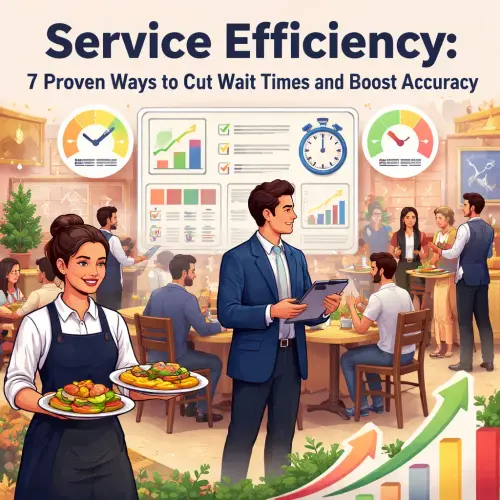
What You Need to Know About Service Efficiency
Walk into any busy restaurant, and you’ll feel the rhythm: servers moving, plates landing, tables turning over. That rhythm is service efficiency in action. When it’s off, customers feel it. When it’s on, they don’t notice it — and that’s exactly the point.
In practical terms, service efficiency measures how fast and accurately a restaurant delivers its product: food and drink. It breaks down into three measurable components: how quickly customers are seated, how fast their order is taken and delivered, and how often the order is correct the first time. Get these right, and you’ll see higher tip averages, better Yelp reviews, and stronger repeat patronage. For a related guide, see 7 Smart Ways to Handle Drink Replacements for Quality Issues.
Why These Three Metrics Work Together
Speed without accuracy leads to returns and refunds. Accuracy without speed leads to frustration. And long wait times for seating kill the guest’s mood before they ever place an order. Each metric feeds the others. For example, a study from the National Restaurant Association found that 68% of diners who experienced a long wait for a table rated the entire meal as “average” or “poor,” even when the food was excellent.
In other words, service efficiency is a system. Improving one lever often helps the others. But you can’t fix what you don’t measure.
Speed of Service — The First Critical Metric
Speed of service measures how long it takes for a guest to receive each milestone: greeting, drink order, food order, meal delivery, check settlement. The most common benchmark for full-service restaurants is 45–50 minutes total meal duration for lunch and 60–75 minutes for dinner.
How to Measure It Accurately
Use a simple time stamp system. At each main touchpoint — host stand, server greeting, order placed, food delivered, table cleared — a staff member records the time. Many modern point-of-sale (POS) systems, like Toast or Square, now offer built-in timers. Alternatively, you can use a free tool like Google Sheets with a shared tablet at the server station.
Benchmarks for Healthy Service Timelines
These are realistic targets for a casual-dining environment, based on data from the National Restaurant Association’s operations reports:
- Table to first drink: under 4 minutes
- Food order to kitchen entry: under 2 minutes
- Kitchen ticket to food delivery: 10–15 minutes (lunch), 12–18 minutes (dinner)
- Total meal duration (lunch): 40–50 minutes
Tips to Improve Speed Without Sacrificing Quality
One common mistake is rushing the kitchen, which increases the chance of mistakes. Instead, focus on cross-training staff so that servers can run food or buss tables during peak rushes. Also, consider using a kitchen display system (KDS) instead of printed tickets — it reduces order-to-fire time by an average of 30 seconds per ticket, according to research by the Cornell University School of Hotel Administration. For a related guide, see Beef Ramen Mistakes: 7 Errors to Avoid for Perfect Broth.
Order Accuracy — The Difference Between Repeat and One-Time Guests
Order accuracy is the percentage of orders that are completely correct — no missing items, no wrong items, no incorrect modifications. It’s the silent killer of service efficiency because one error can set the whole table back 10 minutes while the server fixes the mistake, re-runs the ticket, and apologizes.
How to Track It
Start by tracking error codes. Categorize errors into three types: item missing, item wrong (e.g., chicken instead of tofu), and modification error (e.g., no onions but onions present). Use a simple tally sheet at the expo station. Aim for 97% accuracy or higher. The best full-service restaurants hit 98%–99%.
Common Root Causes
Most errors happen because:
- The server mishears or misremembers the order — especially during peak stress
- The kitchen misreads the ticket — handwriting is still a major problem
- The expo person misses a modifier — “no cheese” gets served with cheese
How to Fix Accuracy with Low-Cost Tactics
One proven fix: implement a “repeat-back” policy. Every server must verbally repeat the full order back to the guest, including all modifications. A 2021 study by the University of Houston found that this single step reduced errors by 22%. Another simple fix: use color-coded tickets or digital tags for allergy/vegan modifiers. You don’t need a fancy system — just a highlighter at the ordering station can work.
Wait Times for Seating — The Guest’s First Impression
Wait times for seating is the time between when a guest arrives and when they are physically seated at a table. It’s often the most emotional metric because it shapes the guest’s initial mood. A guest who waits too long at the host stand starts the meal frustrated, which colors every subsequent interaction.
Measuring Host Stand Efficiency
Start with two numbers: arrival time and seated time. If you’re not using a host tablet system (like OpenTable or Yelp Waitlist at no cost), use a simple clipboard log. Many restaurants now text guests when their table is ready, which reduces perceived wait time by about 40% even when the actual wait is the same.
Benchmarks for Different Formats
- Quick service / fast casual: under 2 minutes
- Casual dining (reservations required): under 5 minutes from reservation time
- Casual dining (walk-in only): under 10 minutes at peak
- Fine dining: under 5 minutes from reservation time
How to Reduce Wait Times Without Expansion
You don’t need to add square footage. Instead, focus on table turnover. The average table sits empty for 5–8 minutes after the guest leaves while staff clean. Cutting that to 3–4 minutes through a “clean as you go” approach can free up 20% more seating capacity during a dinner rush. Also, consider a “lane” system for the host stand — one person to greet and log names, another to guide guests to tables once they’re ready.
Putting It All Together — A Simple 7-Day Improvement Plan
Here’s a practical plan you can run next week. It requires no new software, just a notebook and a team meeting.
- Day 1–2: Measure baseline speed of service for every table during lunch and dinner rushes. Use the milestones above.
- Day 3: Track every error during service. Categorize it by type (missing, wrong, modifier).
- Day 4: Log wait times for every walk-in party during dinner. Note the time of arrival and time seated.
- Day 5: Review the data as a team. Highlight the top three bottlenecks (e.g., “Kitchen ticket-to-food takes 20 minutes” or “Server greeting takes 4+ minutes”).
- Day 6: Implement one change per bottleneck. For example, if the kitchen is slow, add a prep cook during rush. If the host stand is slow, implement the two-person lane system.
- Day 7: Re-measure and compare. If the change worked, standardize it. If not, try a different fix.
By the end of the week, you’ll have a much clearer picture of your service efficiency and at least one reliable improvement.
Useful Resources
For deeper dives into specific measurement techniques and benchmarks, here are two excellent external sources:
- National Restaurant Association — Table Service Operations Research — Official data on service benchmarks, labor costs, and speed metrics.
- Cornell University School of Hotel Administration — Restaurant Operations Studies — Peer-reviewed research on kitchen display systems, order accuracy, and wait time psychology.
Frequently Asked Questions About service efficiency
What is the best way to measure service efficiency in a restaurant?
The most straightforward approach is to track three components: speed of service (time per stage), order accuracy (error rate), and wait times for seating (time from arrival to seated). Use a simple log sheet or POS timer.
How can I improve service efficiency without spending money?
Start with low-cost tactics: implement a server repeat-back policy, use a highlighter for modifications on tickets, and cross-train staff. These changes cost nothing but can reduce errors and speed up service significantly.
What is a good order accuracy target?
Aim for 97% or higher. Top-performing restaurants consistently hit 98–99%. Any error rate above 5% signals a serious system problem that should be addressed immediately.
How do wait times for seating affect customer satisfaction?
Studies show that a wait longer than 10 minutes at the host stand can reduce overall satisfaction by 30%, even if the food and service afterward are excellent.
What’s the difference between speed of service and service efficiency ?
Speed of service is one component of the broader concept of service efficiency. Service efficiency includes speed plus accuracy and wait times, giving a more complete picture of operational health.
Can small restaurants really measure these metrics?
Absolutely. Use a simple spreadsheet or a paper log. The key is consistency, not sophistication. Even measuring one metric for one week will reveal actionable insights.
How does kitchen display system (KDS) improve service efficiency ?
A KDS reduces order-to-fire time by eliminating the need to hand tickets. It also reduces misreads of handwritten orders, improving accuracy. Restaurants often see a 30-second to 2-minute improvement per ticket.
What is the average meal duration for a casual dining restaurant?
For lunch, aim for 45 minutes from seated to payment. For dinner, 60–75 minutes is standard. Longer times usually signal service bottlenecks that hurt both guest satisfaction and table turnover.
Do I need a POS system to track service metrics?
No. You can use a clipboard, a timer app, or a Google Form. A POS makes it easier, but it’s not required. The habit of measuring is more important than the tool.
How can I reduce errors during peak hours?
Reduce the number of handoffs by having one server own each table fully. During peak, add a “runner” who only delivers food and runs drinks, so servers can focus on order accuracy.
What is a realistic improvement timeline for service efficiency ?
You can see measurable improvements within two weeks by focusing on one bottleneck at a time. A full systemic overhaul may take two to three months to embed new habits.
How does staff training affect service efficiency ?
Cross-training (e.g., servers who know how to bus a table) reduces dead time. Regular “repeat back” practice during team meetings improves order accuracy by embedding the behavior.
What role does the host stand play in service efficiency ?
The host stand controls the first impression. If the host is slow to log names or does not update wait times accurately, it creates a bottleneck that affects the entire flow. A dedicated host who focuses only on seating can improve flow by 15–20%.
Can wait times for seating be too short?
Yes. If a table is seated before it is properly cleaned, the guest will have a poor experience. Wait times should balance speed with readiness. A clean, prepared table is always better than a rushed, dirty one.
Is it better to measure speed or accuracy first?
Start with accuracy. If orders are frequently wrong, improving speed will only amplify the errors. Fix accuracy first, then focus on reducing timing.
How often should I review service efficiency data?
Review key metrics weekly with your management team. Share a simplified version (e.g., error rate and average wait time) with front-line staff during preshift meetings.
What is the best free tool to track wait times ?
Google Forms is a solid choice. Have the host enter “arrival time” and “seated time” on a shared form. The data automatically populates into a spreadsheet where you can pivot it however you like.
How do I get buy-in from staff to measure these metrics?
Explain that the goal is not to punish individuals but to improve tips, reduce stress, and create a smoother shift. Show them data from your own restaurant — for example, that a 2-minute improvement in drink delivery correlates with higher tip percentages.
Can service efficiency improve my bottom line?
Yes. Faster table turnover means more covers per hour. Fewer errors mean lower food waste and fewer comped meals. Even a 5% improvement in service efficiency can increase net profit by 3–5%, according to industry studies.
What is the single most impactful change I can make this week?
Start measuring. Pick one metric — wait time for seating, speed of service, or order accuracy — and track it for three days. That alone will reveal a bottleneck you can fix immediately.